


WHY MICA’S LAW
Her name is Mica.
Mica Francis Miller’s story brought national attention to a question survivors and advocates have been asking for years: What happens when abuse is a pattern of control—but the law is looking for a single act?
After Mica’s death in April 2024, her family and advocates pushed for South Carolina’s coercive-control legislation to carry her name. Their effort became known as Mica’s Law.
The 2026 proposal, S.702, sought to add coercive control to South Carolina’s domestic-violence framework, defining it as a pattern that interferes with another person’s free will and personal liberty.

MICA'S
LAW
SOUTH CAROLINA • COERCIVE CONTROL
Mica’s story became part of a much bigger conversation:
How do we recognize abuse before it becomes physical?
UNDERSTANDING COERCIVE CONTROL
There’s a name for this.
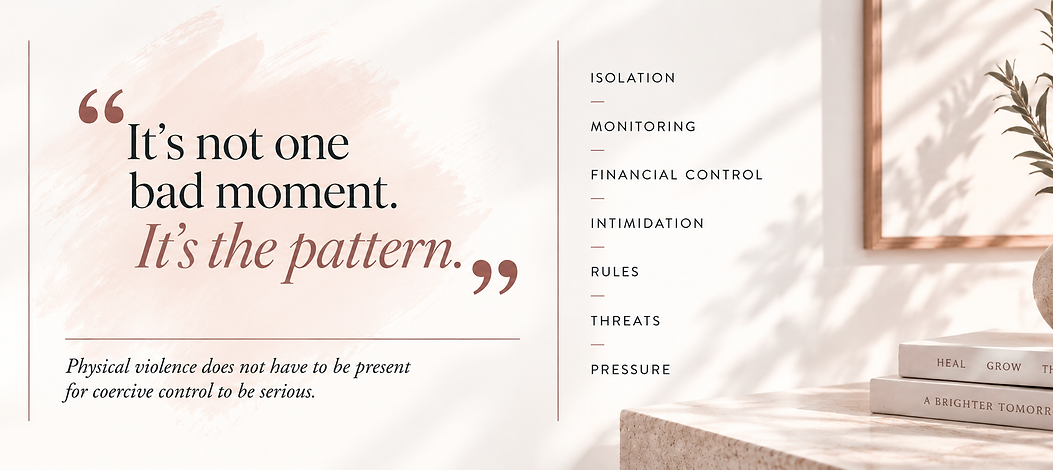
Sometimes abuse doesn’t look the way we were taught to expect it to. There may be no bruise. No single moment you can point to. Instead, life gets smaller—little by little.
Coercive control is a pattern of behavior used to gain power over another person’s life, choices and freedom. It can include isolation, monitoring, financial control, intimidation, rules, threats or pressure.
WHAT IT CAN LOOK LIKE
Control doesn’t always
look like control.
It can look like concern. Protection. Jealousy. “Just checking in.” Handling the money because it’s easier. Wanting your location because they worry. Slowly, the choices that used to be yours may stop feeling like yours.
Coercive control is about the pattern and its effect on a person’s freedom and autonomy, not simply one behavior viewed in isolation. Official guidance describes patterns that can involve isolation, monitoring, financial control, intimidation, threats, humiliation and regulation of everyday life.
01 — ISOLATION
Making it harder to see friends or family, work, participate in community, or maintain other sources of support.
04 — RULES + EVERYDAY CHOICES
Dictating what you wear, where you go, who you speak to, or what you are “allowed” to do.
02 — MONITORING
Tracking where you are, checking your phone or communications, monitoring your activities, or expecting constant access to you.
05 — INTIMIDATION + THREATS
Using fear, threats, humiliation, or consequences to make compliance feel safer than saying no.
03 — MONEY + RESOURCES
Controlling spending, accounts, employment, transportation, or access to things you need.
06 — TECHNOLOGY
Using phones, apps, accounts, location services, or other technology to monitor, harass, or control.
YOU DON’T HAVE TO FIGURE THIS OUT ALONE
What happens next matters.
If something on this page felt familiar, you don’t need to have the perfect words—or be certain what to call it—before reaching out for support.
